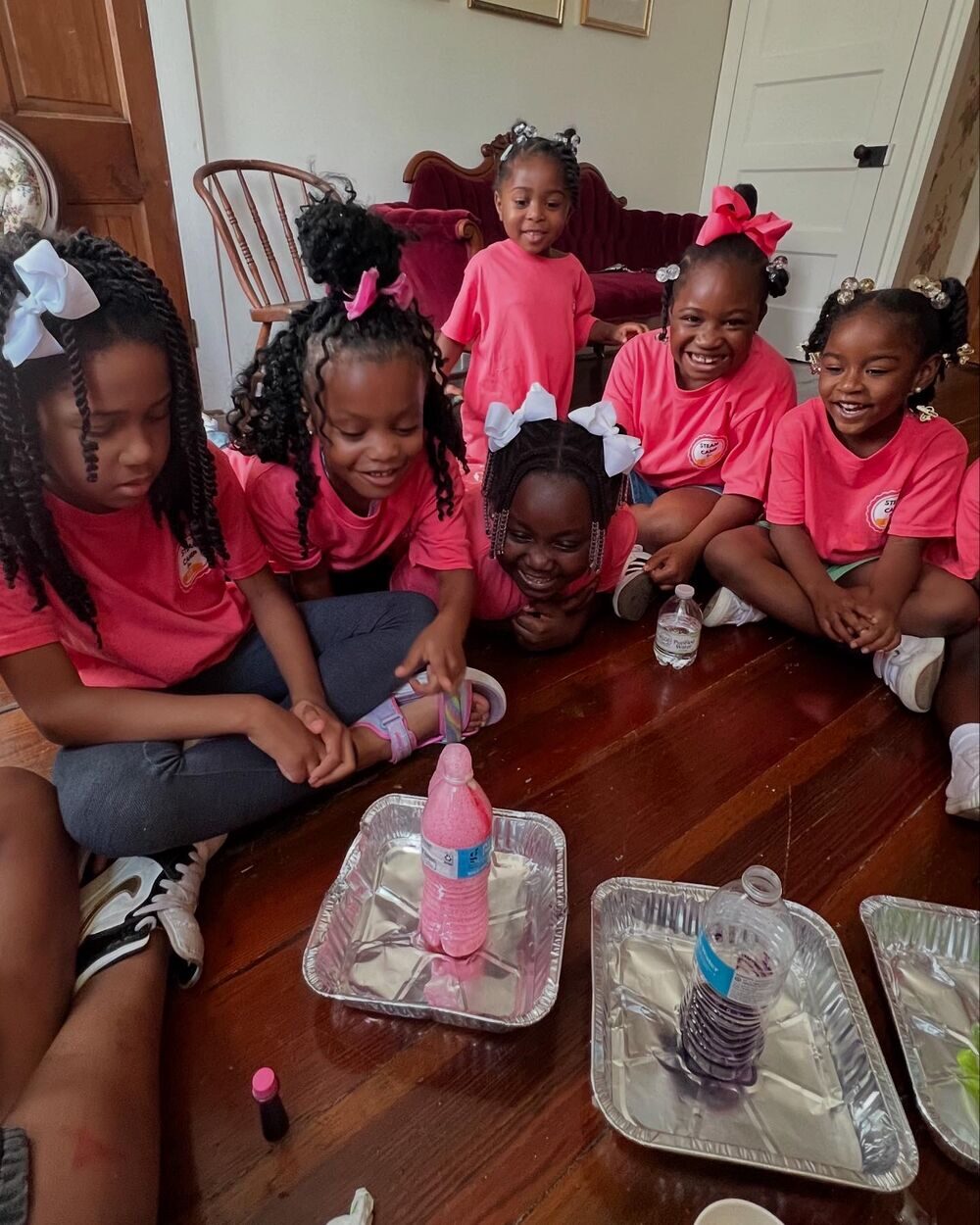
One of the most common things parents say after their first STEAMCamp session is: "How do I keep this going at home?" The good news is that some of the best science happens in the kitchen. No special equipment, no expensive kits — just curiosity and a few things you already own.
Here are five experiments we love, each with a real concept behind it and instructions simple enough to do right now.
1 Baking Soda & Vinegar Volcano (Classic for a Reason)
You'll need: Baking soda, white vinegar, dish soap, food coloring, a container
The science: This is an acid-base reaction. Vinegar (acetic acid) reacts with baking soda (sodium bicarbonate) to produce carbon dioxide gas — which is what creates all that satisfying fizz. Add a squirt of dish soap to make the bubbles last longer.
Make it better: Ask your child to predict how changing the amount of baking soda affects the size of the reaction. Test it. Record the results. You've just done real experimental science.
2 Dancing Raisins
You'll need: A clear glass, club soda or sparkling water, a handful of raisins
The science: Drop the raisins in and watch them sink — then slowly rise, then sink again. CO₂ bubbles from the carbonation attach to the raisins' rough surfaces, making them buoyant enough to float. When the bubbles pop at the surface, the raisins sink again and start collecting new bubbles.
Make it better: Try smooth grapes vs. wrinkled raisins. Which collects more bubbles? Why might surface texture matter?
3 Milk Plastic
You'll need: 1 cup whole milk, 4 tsp white vinegar, a saucepan, strainer, paper towels
The science: Heat the milk gently, add the vinegar, and stir until curds form. Strain them, press them together, and let them dry. You've just made casein plastic — one of the first plastics ever created, and still biodegradable today.
Make it better: While it's still warm and pliable, shape it into something. Let it harden overnight. This opens up incredible conversations about materials science, history, and sustainability.
4 Oil and Water Density Tower
You'll need: A tall clear glass, honey, dish soap, water (with food coloring), vegetable oil, rubbing alcohol
The science: Different liquids have different densities. Pour them carefully in order from heaviest to lightest and they'll layer without mixing: honey on the bottom, then dish soap, then colored water, then oil, then alcohol on top. It looks like magic — it's physics.
Make it better: Drop small objects in and predict which layer they'll rest in. Try a grape, a raisin, a small piece of plastic, a cherry tomato.
5 Oobleck (Non-Newtonian Fluid)
You'll need: 2 cups cornstarch, 1 cup water, a large bowl
The science: Mix and you'll get a substance that behaves like a liquid when you move slowly through it but becomes solid when you apply sudden force. It's a non-Newtonian fluid — it doesn't follow Newton's laws of viscosity. Punch it and it's hard. Hold it and it drips through your fingers.
Make it better: Put it on a subwoofer speaker and play bass-heavy music. The sound waves will make it dance and spike. The internet calls this "cornstarch dancing" and it's genuinely magical to watch.
The Real Point
The point of these experiments isn't the result — it's the questions. "Why did that happen?" "What would change if we used less?" "What would happen if we tried it with hot water instead of cold?" Science at home is about building the habit of curiosity. Every question your child asks at the kitchen table is one more step toward a kid who isn't afraid to wonder.
For more hands-on experiments — and a week your child will talk about for years — check out our upcoming camp sessions.