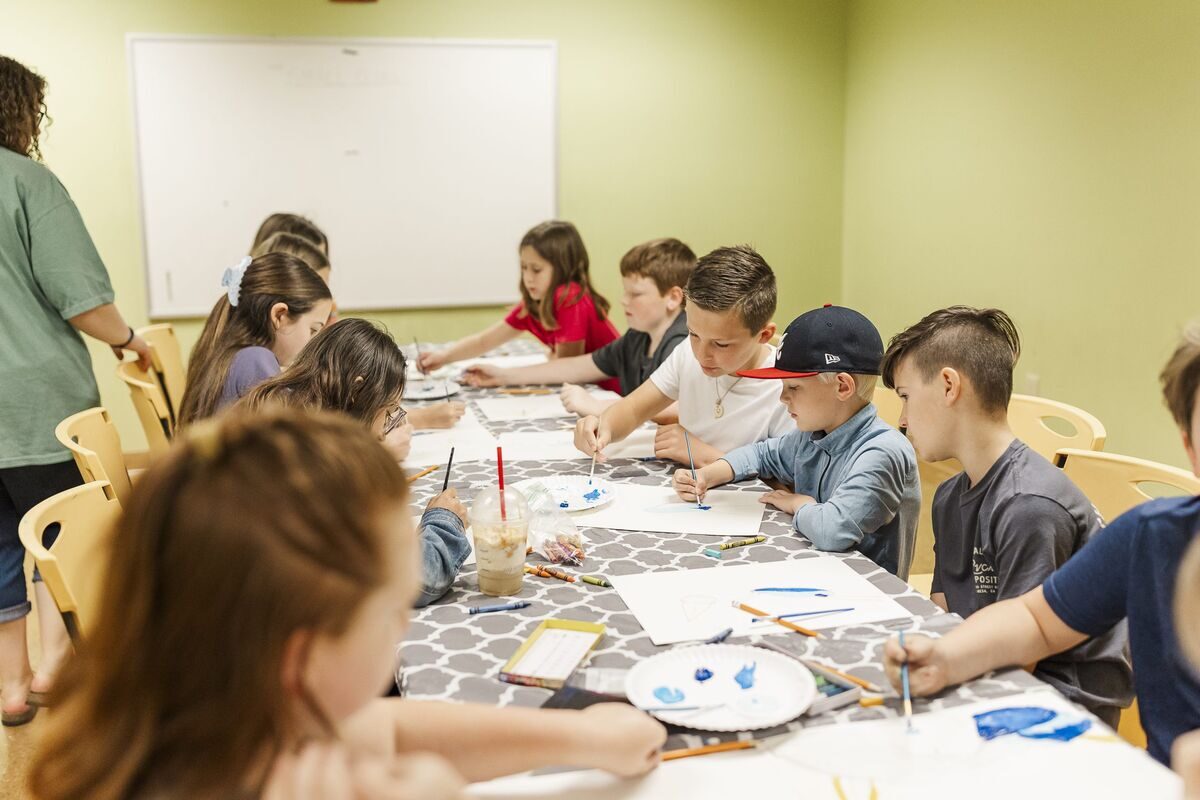
We get the question a lot: "Why STEAM and not STEM?" Sometimes it's genuine curiosity. Sometimes it's a challenge — as if putting Art in the acronym means we're not serious about the science. We're very serious about the science. That's exactly why we keep the A.
Art and Science Have Always Been the Same Thing
Leonardo da Vinci kept notebooks full of anatomical sketches and engineering drawings, not because he couldn't decide which one he was, but because he understood that rigorous observation — the kind artists develop — is the same skill that makes great scientists.
When a child spends 20 minutes trying to capture the exact color of a shadow, they're training their eyes to see the world more precisely. When a child figures out how to make a sculpture balance, they're solving a physics problem. The tools are different. The thinking isn't.
Creativity Is Not Optional in Science
The scientific method is fundamentally creative. You have to imagine a hypothesis before you can test one. You have to visualize a solution before you can build it. You have to ask "what if" before you can find out.
Children who engage deeply with art develop comfort with ambiguity — there isn't always one right answer, and the process of making is as important as the product. That comfort translates directly into better scientific thinking. Kids who aren't afraid of a blank canvas aren't afraid of a blank whiteboard.
"The most creative scientists I've met are the ones who also paint, or play instruments, or write. The two things aren't in competition. They're the same impulse." — Lindsey, STEAMCamp Founder
What This Looks Like in Our Camps
At STEAMCamp, Art isn't a separate elective or a reward at the end of the day. It's woven into the science:
- Campers design and build structures, then document them with detailed observational sketches
- Chemistry experiments often include discussions of color theory — why does the color change, and what does it tell us?
- Our early childhood programs always pair a science concept with a creative project so children can express what they've learned in multiple ways
- Engineering challenges include a design phase where campers draw and iterate before building
The Research Backs This Up
A growing body of research supports the integration of arts into STEM education. Studies from institutions including the National Endowment for the Arts have found that students who participate in arts-integrated learning show stronger engagement, better retention, and higher test scores in STEM subjects — not lower.
This isn't surprising to anyone who has watched a child who was "bad at science" suddenly light up when we connected a concept to something they could draw, build, or make. The art opened a door the equations couldn't.
We're Not Apologizing
There are plenty of STEM programs out there. We built something different on purpose. We want children who can think rigorously and imagine boldly — who can debug code and appreciate beauty — who understand that the world's most interesting problems are solved by people who can do both.
That's what STEAM is. And we're not dropping the A.